"NE PLUS ULTRA" is an interview series curated by NOW-ID Artistic Director Charlotte Boye-Christensen to share the stories of local, national and international artists and designers creating extraordinary, inspiring and impactful work. The idea is to share a little bit about who they are, what their process looks like, who inspires them and how they conceptualize and shape ideas.
The first interviewee in this series is the unequivocal Mark Hofeling.

Mark Hofeling (Photo: Disney Channel Publicity)
Mark (Production Designer/ArtDirector), has designed and art directed over 60 productions for film and television. Twenty of which were Disney Channel Original Movies, including the three most watched cable movies of all time; High School Musical 2, Wizards of Waverly Place the Movie, and Teen Beach Movie. Other Hollywood productions Mark has worked on include "The World's Fastest Indian", "Con Air" and “Army of Darkness”. Mark also designs furniture, objects, lighting and spaces - and in that capacity has worked with various clients at the Sundance Film Festival, and various local organizations and businesses in Utah, including occasional collaborations with NOW-ID.
I have known Mark for close to seven years now and he is forever surprising, limitlessly creative/curious and has the fastest mind and quickest wit of anyone I know. It was obvious to choose him first for this series as I am forever inspired by his direct and uncompromising approach to life and his well of ideas and skills. Mark creates, builds, draws, writes and thinks like no one else and is one of the best in his field.
Charlotte Boye-Christensen
Tell us a little bit about your background; where are you from and how did you become a production designer?
I was born and raised in Salt Lake City. I was 9 years old when my dad took me to see the first Star Wars movie on opening day in the summer of 1977. To name-check Star Wars as an inspiration is obviously cliché, but the arc of my hyperactive, pre-teen creative mind and George Lucas' original masterwork intersected in the vast emptiness of the post Vietnam American wilderness. When the Millennium Falcon screeched across the screen, my dad leaned over and said, "There are people who make all that, you know?" And the spark was struck. I knew my path led behind screen and through the looking glass.
Despite that nascent moment of childhood ignition, my profoundly religious family and community life was colorless, fearful and extremely hostile to art and free expression. Before I understood the word "gay", there was a confusing part of myself I instinctively knew to hide as deeply as I could dig if I wanted to survive my family life. Taking not only myself but also my creative curiosity underground was my pathway to survival. Naturally, it was painful and confusing, so only in hindsight can I make much sense of it.
The mediocrity of high school led to a lackluster college life. While all I wanted to do was work in film, I had no tools, idea or help to get there. I was paying for an art degree with a swimming scholarship. Art and swimming were both extremely demanding and very divergent pursuits that I couldn't fuel indefinitely. I was depressed, in the closet, and frankly a far better swimmer than an artist.
To make a long story short, a massive pile of junk my family stored next to the freeway, led to a random opportunity to work as an unpaid production assistant on a low budget horror movie. I could have died. I tried like mad to impress the art director. Whatever I did worked, because he flew me to the North Woods of Wisconsin later that year to make three low budget horror movies. I had run away and joined the circus. I had found my tribe, my life was literally saved.
Once I was in, I found my purpose at last and ran as fast as I could toward the goal of being a production designer. I was granted my wish of designing my first movie a few years later.
What does it mean to be a production designer, what responsibilities do you have and who do you mainly collaborate with on set?
A great way to describe the job of the Production Designer is that we are in some way responsible for everything on screen that isn't alive. Not only is the designer in charge of set design and construction but also location selection, props, set decoration, color palette and an eye toward costume. As far as collaboration, the designer is the absolute nexus of creative and technical collaboration.
The designer manages a huge department- the art department- that encompasses both white-collar designers and artists and blue collar carpenters, welders and painters. It is a negotiation between bean-counters and money-men in production and figuring out how to communicate ephemeral creative ideas to a guy operating a crane to move your set-pieces around, and pouring over piles of textiles, table legs and picture frames with your trusted decorator. It's discussing what kind of ashtray or suitcase or pistol a character might have with your prop master. More than anything, what the production designer and their vast stable of professionals do is create backstory. Our long hours of discussion and preparation result in the first few seconds of an image telling you more about a place or a character than pages of exposition can. As the architects of the visual and the narrative, we've usually thought more about who a character is and what their life so far looks like than most directors or actors ever do.
As far as who a designer collaborates with on set, we are part the Big Three. That being the director, the designer and the director of photography (my DP friends will note my reclaiming the designer's rightful top billing). These three positions (minus the writer who is often no longer involved when a movie goes into production) are the creative troika that make the movie.
While we three are backed up by a huge amount of money, muscle, genius and ability, we are generally the creative professionals that set the tone of a project.
Recently, I had you come and talk to dance students at Tanner Dance (a dance institute for children and teenagers at the University of Utah) and you spoke about your responsibility to create a space that is aligned with the choreographer’s vision (This was for the High school musical series) and yet also safe for the dancers – can you elaborate on that? And does it help that you have worked with the same choreographer (Kenny Ortega) on a number of films and you know what he is looking for aesthetically?
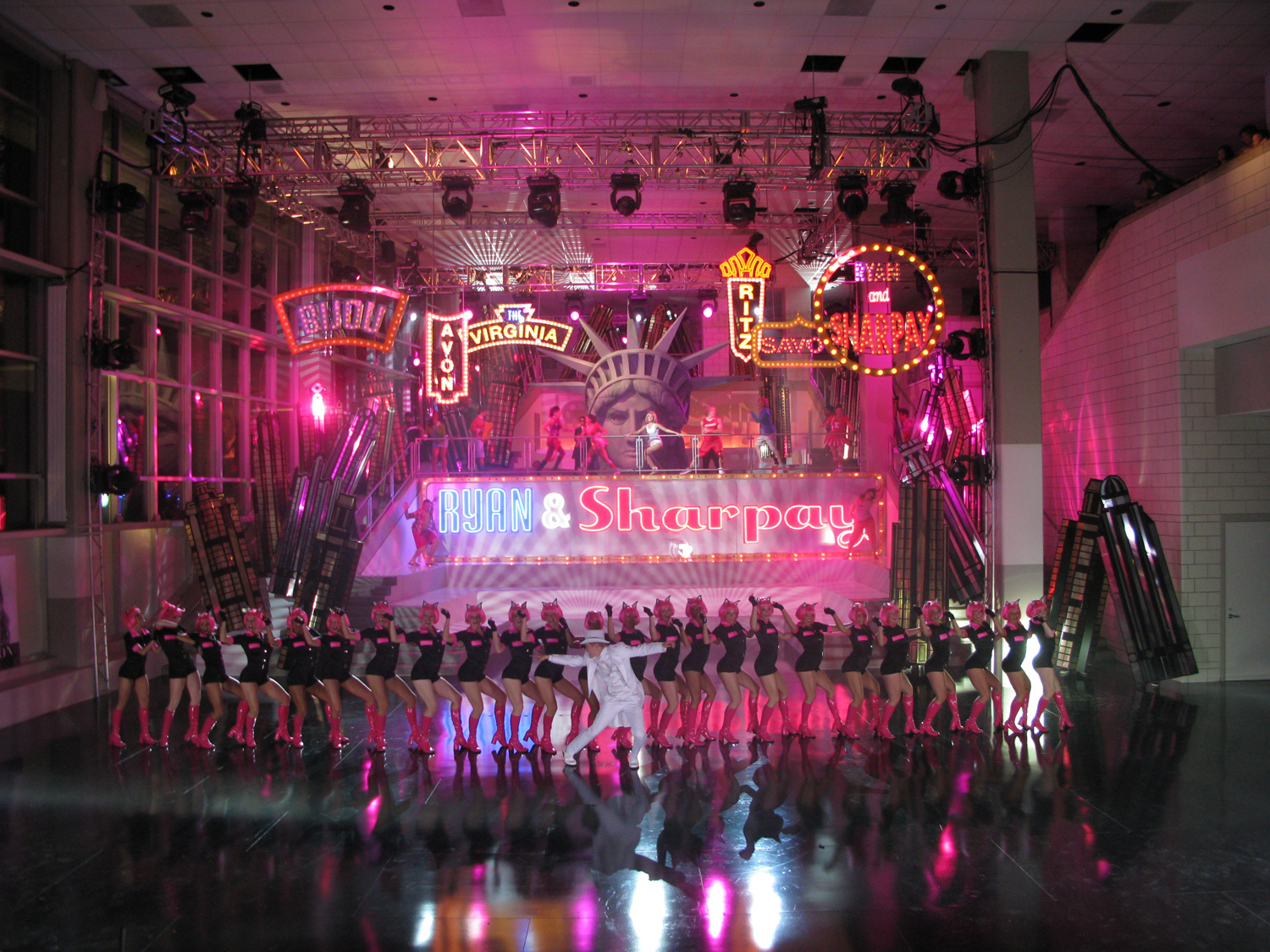
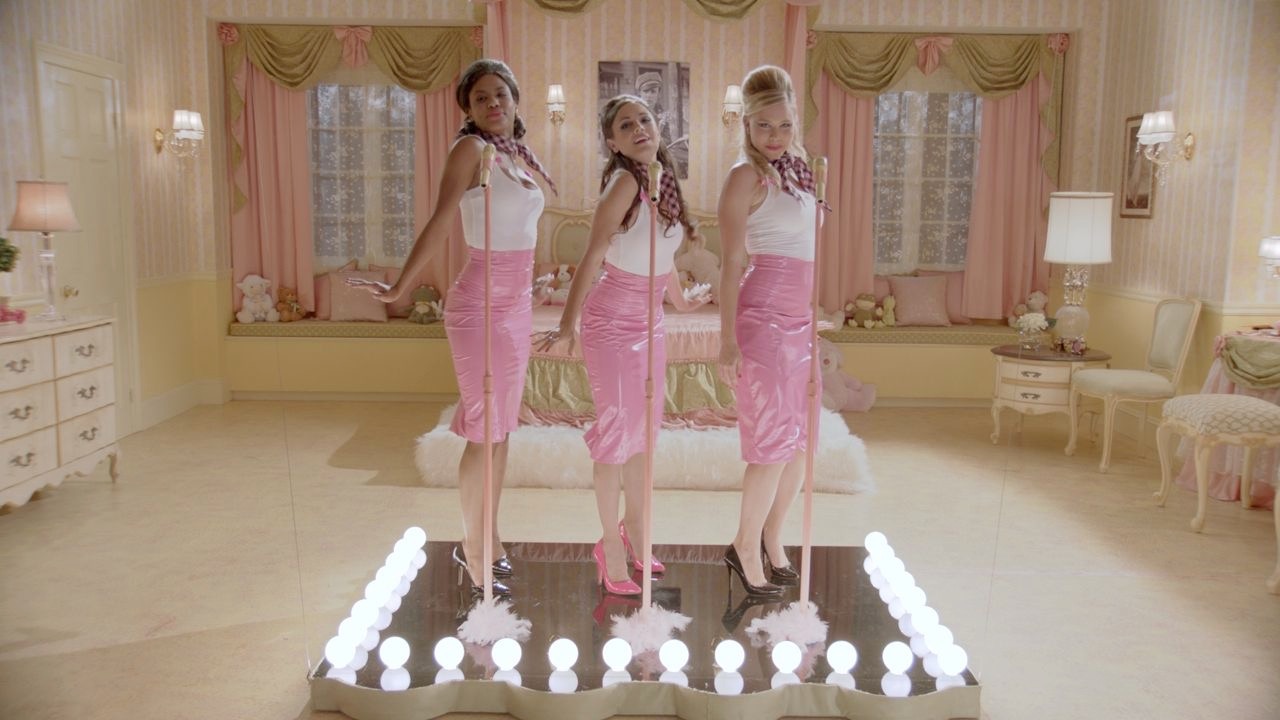
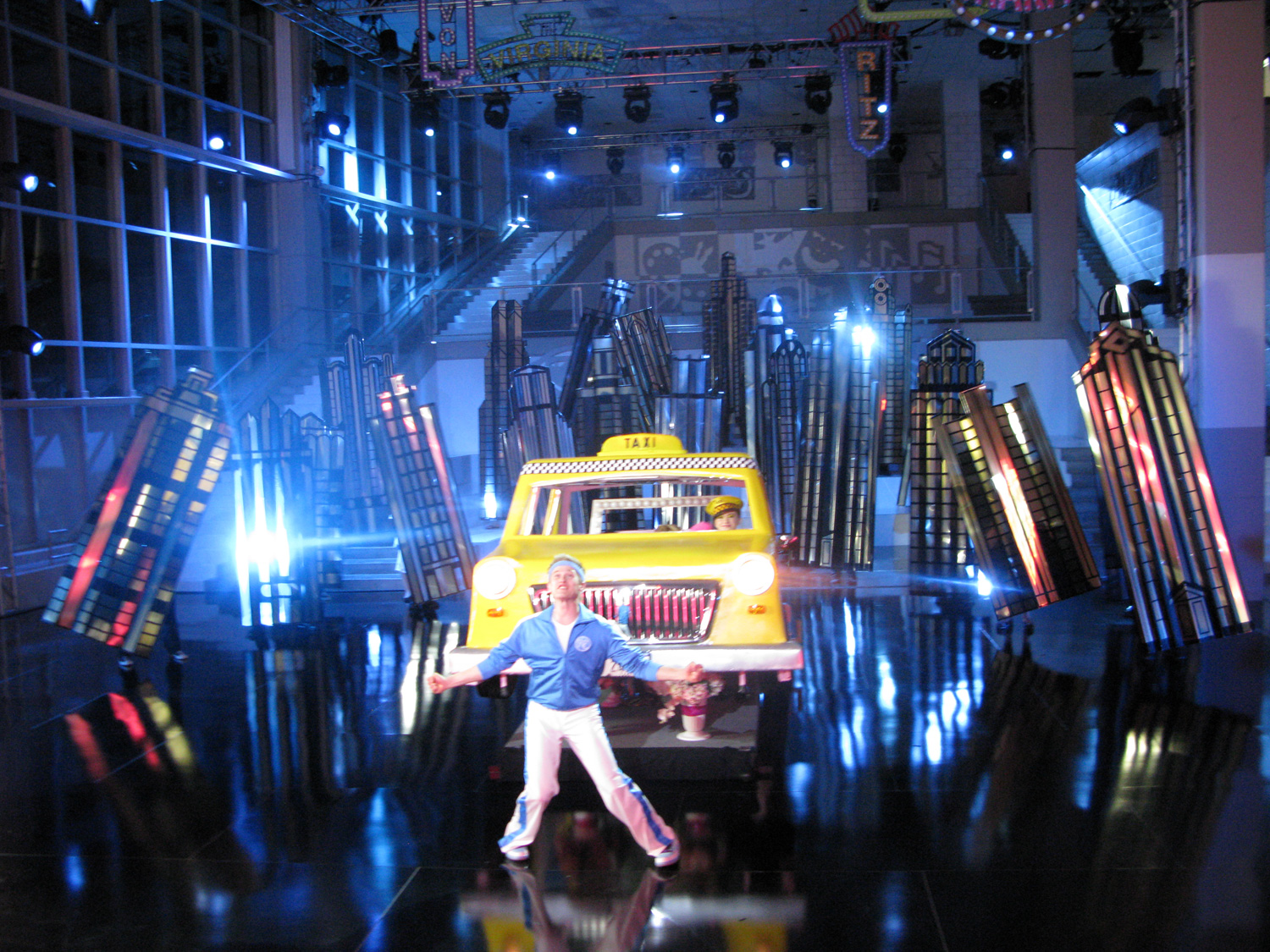
Design for film is a collaborative discipline. While no two designers would read a script and end up with the same look, they would all still be reading the same script and follow the lead of the director. As for dance in film, generally the dance takes the lead, and as a designer I support and augment the needs of the movement. Obviously spatial requirements are key but, after a long learning curve I may know better than almost any designer how to make an environment safe and flexible for dancers and performers.
The process of choreography for musical film is amazing to be a part of. A musical typically has 10 or so choreographed songs. Once the audition process has been completed, the dance team usually has a month or less to conceive, workshop, rehearse and memorize all 10 pieces. This month is usually late in a movie's prep period and most producers and money people are accustomed to all the budgets being locked and finalized by this time. But as the dance develops, all kinds of requests start pouring in from choreography :- "we need a curved staircase that rolls away", "we need a dressing screen that tilts down and becomes a stage", "we need a giant Statue of Liberty head that turns around", "we need 50 fish puppets" and on and on. A designer new to the process would melt down under the demands. I've learned to try to coach production through this unusual territory, since we really have to give choreography everything we can.
I have learned that the dancers, usually quite young, are trained in the art of perfection, but always try to impress the director. So anything in a 50 foot radius that isn't built to be jumped on, swung from or used as a launching pad for a back flip represents a hazard. Every table, railing and chair in my environment is double thickness, has extra welded structure or is bolted to the floor.
I have learned an enormous amount in my five films with Kenny Ortega. He is a great friend and probably the most important creative mentor in my life. Having started my work life in the bargain basement, low budget world, I got used to automatically hammering my concept down to fit the modest means of small productions.
Kenny reminded me to dream bigger. He always starts with what a thing ought to be, and then we figure out how to back into paying for it. By inviting me into the choreographic process starting with the first auditions, he helped me develop a completely holistic approach to designing for him.
Tell us a little bit about the highlights of your career so far?
I am supremely fortunate to have had more highlights than the opposite. I have been crazy-lucky that way.
One highlight that has really ripened with age is that I was a puppeteer on what would become the cult classic Army of Darkness. It is crazy the response I get when random people find that out. Not only did I puppet tons of skeletons and zombies, but if you watch the final battle, I made all the musical instruments and weapons for the puppets. It was a really fun show.
Another highlight was the first time on set that I saw a complete run through of a musical number. It was the first High School Musical. The number was called Status Quo, a big, bright full ensemble piece in a tiered cafeteria. I actually got chills. It's rare to see something on set that makes you want to applaud.
Mostly though, the highlights for me are parachuting into a new city and meeting up with a whole new team who are going to go through the crucible for the next few months and help me achieve the vision. It is not a solitary life, and the social aspect is one of the real highlights of my job. I keep in touch with crew friends all over the place.
Can you talk about your process?
Designing for film is all about process. From beginning to end my involvement is less than six months. That's from the first time I read the script to me getting back on a plane to go home. In that time we ramp up, from the director and I scouting locations in a van, to more and more crew, until scores and scores of people are making the actual shoot happen.
While a script is the skeleton of any show, it usually has precious little to say about what it's world looks like. It is up to me and my team, as well as several other departments to hang meat on those bones. After more than twenty years at it, I've really come to trust my first instinct when I read a script. And not only do I trust the basics of that first mental image, but I have become really good at communicating and selling it.
Once I've sold the director and production on it, then the real work begins: Creating actionable building drawings, budgeting, scheduling, and assembling the intricate puzzle of ten different departments getting into and out of sensitive locations and sets that are at the moment just piles of lumber and ambition. But from day one on a show, my internal process is to sit with an 11x17 vellum pad and let the pencil show me what is bubbling in the bottom of my brain. Along with pulling a couple key images from the Internet, the process of the sale begins with a few simple sketches on paper and the gift of gab to either convince or BS my way through critical early meetings.
The other important part of the process is being a people person. Because of the high output and very short time in which movies are made, and the huge number of people required to make it happen, a designer has to be extremely capable of communicating clearly and quickly with a wide variety of people.
As a younger man I worked for designers who were weird about information, playing their cards way too close to their chests, controlling who knew what. I hated that method. If we are paying all these talented people for their time and experience, I also want all their brain power and experience to make me seem even better than I am, so I am all about getting as much information to as many people as possible. The walls of my department are plastered with drawings and photos covered with notes. I usually also make a detailed picture book I hand out to all my department heads with every set and location noted in detail. When you bring people inside the process, they are much more willing and interested in giving you their best ideas, making for a far better outcome.
What was the worst experience you have had as a production designer?
Honestly most of my worst experiences have been self-inflicted. Most of my bad days were a result of some insecurity having prevented me from speaking up in weeks prior about a red-flag or something the director thought he was going to get but I couldn't beg borrow or steal the time and money for. I started in my profession very young, so it took me a long time to find my confidence and my voice, and to learn to throw around the weight my position affords me. In the past five years or so I have found that voice and consequently have had far fewer bad days, however I'm sad to report my inner coward still lingers in the shadows, and so the work continues.
Who are some of the people who have inspired you in your work and why?
As far as known people, my friend Kenny Ortega, Julie Taymor, Ken Adam, Andrei Tarkovsky, David Eugene Edwards, Shane MacGowan, and the incomparable Wayne White. But my real inspiration comes from people I will never know. When I crack my knuckles and plow through piles of books and endless internet searches, my inspiration comes from nameless people whose house is wrong in the right way, whose office is so perfectly bland it sings to me, whose trailer is perched just so on the edge of a garbage strewn ravine, whose anonymous factory has the perfect combo of white tile and red and yellow safety striping. Huge personalities and geniuses make a lot of noise in the world, but it is inhabited by countless normal folk chipping away at life's labors. And those are the people from whom I usually take my creative cues.
What is your favorite movie?
That is a brutal question. How about a few in no particular order?
Blade Runner
Stalker
2001
Evil Dead 2 (one of the most influential movies among other filmmakers. Someone who knows what to look for can see homages to Raimi's masterwork by other film makers. I've done one myself!)
Mishima (if you haven't seen it, it's a must)
What we do in the Shadows (a recent gem)
The Proposition (the Nick Cave one, not the Demi More one)
Once Upon a Time in the West (Leone's masterpiece)
What do you consider to be the most significant film ever made and why?
Oye... That is so incredibly subjective. I'm not much of a formal film historian, so I can only take a stab. My hunch would be the Wizard of Oz. The incredible artistry and technical wizardry (sorry for the pun) were unparalleled for long after its time. For a film of its achievement to be made before World War II is astonishing.
What is your favorite piece of art?
Weirdly enough I've always loved the Venus of Willendorf. Something that paired-down, reductive and perfect form our collective pre-history is glorious to me. I've also always felt very close to Picasso's Guernica. Seeing it in person in Madrid was a revelation. Apparently I'm a sucker for primitivism.
Who is your favorite Designer?
Hard to say. Dean Tavoularis (Apocalypse Now, The Godfathers) is one of the great masters. The all time great in my opinion is Ken Adam (Dr. Stranglove, Goldfinger). My real personal favorite is also a dear friend of mine, Therese Deprez. She is an American treasure, having done Summer of Sam, Hedwig and the Angry Inch and the Black Swan. I may be a little biased because we lived and worked together 25 years ago on three crazy horror movies when we were just kids.
What is your favorite city that you have visited and why?
Another tough one. For a kid raised in the blandness of 70's Salt Lake City, there is something very special about Old San Juan, especially in the madness of the San Sebastian festival. I spent five months working in Barcelona, which also tops my list. I love Mexico City, I love Austin, and I found a way to love Atlanta. But my real favorite was Vancouver – somehow in five months there I missed the rainy part. It just clicked for me there. I hope to be back there next year for another extended period.
What do you think the biggest misconception is about making movies?
That it is glamorous. Making a movie may be fun and rewarding, but more than anything else it is like digging ditches. The hours are crazy-long (often times 14 hour days are the base) and, in the creative departments seven day weeks are not uncommon. Often times making it to a remote location for a morning shoot means getting out of bed at 3 a.m. porta potty's are too frozen to allow bare flesh to touch the seat in the High Uintas in December and dizzyingly toxic on the Salt Flats in August. On Army of Darkness, the giant lights attracted moths and all forms of pestilence in such swarms if you took your dust mask off long enough for a sip of water your mouth and nostrils would clog with insects. Junkies fling baggies of shit and piss out of the upper stories of their tenement motels on the film crews in the very cinematic alleys in Vancouver and Hamilton during night shoots. I had a plastic shopping bag of very liquid excrement explode on the tailgate of the truck I was walking into under the 1st street bridge in LA years ago, splattering my clothes and hair. When I looked up, the junkie who threw it asked if he could be an extra in the movie, and flashed me a hopeful thumbs up. Like the movies themselves, the glamor is an illusion.
What is your favorite quote?
"There's always money in the banana stand" - George Bluth Sr.
You are also an artist and a designer outside of the movie business, can you talk a little bit about some of the projects that were the most meaningful to you and why?
Most of my creative output over the past 25 years has been consumed by the film business. It's only been in the past six or seven years that I have realized that I needed to find other outlets for my creative urges. I have been bothering and horrifying my friends with stories from my Dickensian youth for years. A few years ago my husband Jesse wondered why I had never written them down. So I accepted the challenge and have found the task of trying to make the written word as amusing and engaging as the spoken word an incredible exercise.
Since drawing is a very work-a-day part of my life, I rarely do it for fun or personal artistic expression. But I have recently picked up sculpting and have found it equal parts rewarding and infuriating. I started playing in clay to see if I could make the image I saw in my head appear. And happily I can, but I had no idea it would be such a damned emotional roller coaster. Over the years I have also made furniture and lighting as the fancy strikes me, something I need to get back into more routinely.
Survival and advancement in the industry requires a thick skin and a sharp tongue. If you can't throw some elbows, it's not a happy place. I've recently been very fortunate to be asked to guest host a podcast my friends Frank and Dan produce. Apparently there are people who enjoy hearing my acerbic take on life. Who knew? It can be found at TGIA podcast. That’s been another really enjoyable creative outlet.
You are currently in the middle of helping the Leonardo (A science museum in SLC) with an exhibit on Flight, can you talk a little bit about this exhibit and what excites you about working in that space and conceptually on that theme?
My friend Jann Haworth at the Leo has been trying to find the right project for me to engage with over there for a while now. FLIGHT is their first big, permanent exhibition. The name clearly describes the idea of the installation, basically how humanity has engineered it’s way into the air. My business partner Matias Alvarez and I made a preliminary pitch that I think hit the notes of boldness and physicality the Leo was looking for- something splashy, non-static and with multiple intellectual points of entry. Since I have spent a lot of my professional life engaged in dialogue with my inner ten year old, I knew what he would want in the experience. I pitched one word as an ethos -permission.
With the Leonardo, as with every "civilian" ( my term for non-film industry) design project I engage in, the basics of my movie experience still apply. Whether it's a restaurant, a bar, or an exhibition, it's still show business. I think a lot of non-industry designers may not intuit that on a basic level. It's about creating an immersive, stimulating and satisfying experience where care is taken to never "see off the set".
The Leonardo project is particularly exciting because they are so open and unafraid of thinking big, of unconventional approaches to deconstructing the museum experience and embedding fun into every crack. And, for me, the idea of a tangible, permanent, tactile thing that so many hands can touch, and so many minds can recall for decades when they think of their first understanding of flight is an awesome responsibility and a fantastic opportunity.
Why are you based in Salt Lake City? I remember driving around with you at some point on the west side and you kept pointing out areas that have inspired you or that you see are changing – do you think SLC is in a transformative state at the moment and what are the main things that you would love to see happen in this city.
I was born in 1968, to people that found Salt Lake far too modern for their Byzantine tastes.
I have long said that everybody's from somewhere. Napoleon Bonaparte was born in the Corsican sticks. Anton Chekov was born in a remote town by the Sea of Azov. Even Gene "the Demon" Simmons of KISS is from the small town of Haifa, Israel. And it's not their goddamned fault. I spent a long time being ashamed of the bland, conservative backwater I was from.
But after fleeing from the culture that nearly killed me, and spending awhile in the limbo of new-found freedom and discovery, I found my real family here in SLC- people of worth who gave me space to find my way from the sloppy mess I was to the much more refined or at least tolerable mess I am now.
I have lived and worked in so many places - LA, Atlanta, Puerto Rico, the wilds of Idaho and Upper Michigan, Wendover (no shit, I have spent almost a year of my life in that hellscape), Toronto, Vancouver, Wisconsin and even Spain. But some weird gravitational pull kept me coming back to the city I never really understood.
What I didn't realize I had lacked in my many years in all those other places came into sharper focus after I really drilled down into what left me a little directionless out there. Whether I liked it or not, my personal creation myth is inseparable from the stupendously weirdand improbable existence of this Zion that was never meant to be. What I came to understand what this city gave me that none of those other places did was an obvious, all-powerful bad guy to live in opposition to. No other city I ever lived in had such a massive, singular force that spent 24/7 and zillions of tithing dollars trying to snuff out everybody else's fun and basic freedoms. For better or for worse, my life is defined in opposition to one of the world's great buzz-kills. But leaning against it is hardly lonely. The opposition to Mormonism’s 19th century, anti-progressive balderdash is an amazing community pot-luck of good folk of every stripe- straight, gay, black, brown, white, and every color of humanity's rainbow.
We make fewer movies here than we used to (and we used to make a lot) but we still make some. Although I work here very seldom, it's where my husband and I have decided to call home. Salt Lake is a place where new ideas can still be workshopped and being in the creative community puts you into a fraternity of like-minded people. To all the rednecks and conservatives who love to tell people like me to leave, I say, “you fucking leave”. This shit is as much mine as anybody else's. People stronger than me in long, lonely years past made it a more and more tolerable place to be. It's up to us to drag it kicking and screaming into the 21st century.
Who is the one person that you have always wanted to work with?
That’s a tough one. After the first time I watched Blade Runner 25 years ago I wanted to stalk Ridley Scott until he let me into his world. More realistically, I would love to work with John Waters or Wes Anderson. Such quirky, deliberate aesthetics are extremely attractive to me. I have been working every angle to try to get my foot firmly in the door with Matt Stone and Trey Parker should they get the Book of Mormon movie off the ground. I can't conceive of a more convincing reason for my existence on this earth than designing that.
Looking towards the future – where do you want to be and what do you want to be doing in 25 years?
Alive and well would be a good start. As much as I want to die with my boots on and be carried off set by the grips, the rigors of movie making can get pretty hard to endure late in life. So I do have a dream of taking my years of collected wisdom and creative near-misses and teaching at someplace like SCAD (Savannah College of Art and Design). Living in a small apartment off Chippewa Square in Savannah, wearing seer sucker suits and carrying a smart walking stick, passing on whatever of value I can to a generation yet unborn sounds like perfect final chapter to me.
To see more of Mark's work go to: http://www.markhofeling.com